MEDIA WATCH · OPINION · 23 NOVEMBER 2026
Three ABC programs in 34½ hours. Who framed the story?
Ellie Mai Large
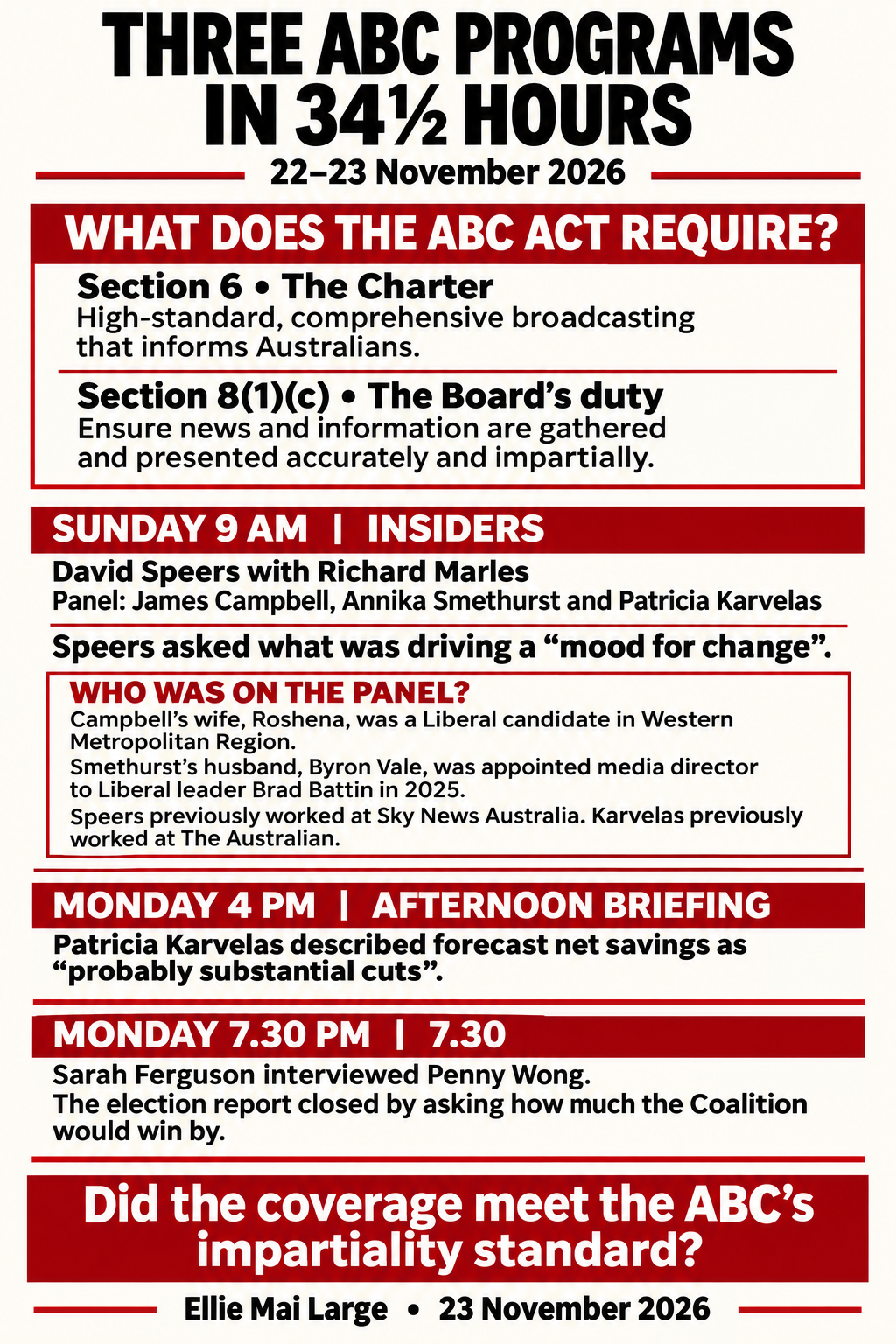
From 9 am Sunday to 7.30 pm Monday, just under a day and a half separated the start of Insiders from the start of Monday’s 7.30. I recorded both, along with Afternoon Briefing. Before I get to what infuriated me as a member of the Australian Labor Party, here’s who was on our screens.
Sunday 22 November, 9 am — Insiders, Caroline Springs
David Speers presented. Deputy Prime Minister Richard Marles was his principal guest. The panel was James Campbell, Annika Smethurst and Patricia Karvelas. The program also showed interviews with Victorian Premier Ben Carroll and Opposition Leader Jess Wilson. Watch Insiders.
James Campbell was introduced as associate editor of News Corp’s Herald Sun. His wife, Roshena Campbell, is a Liberal candidate for Western Metropolitan Region in the election he was discussing. The ABC’s Politics Now disclosed that in its October episode notes. I found no spoken disclosure in my Insiders captions. Was it shown on screen? Podcast editor’s note · Campbell research and candidate sources.
Annika Smethurst was introduced as Victorian affairs editor of The Age. She previously worked as national political editor of the Sunday Herald Sun and Sunday Telegraph. Her husband, Byron Vale, previously advised federal Liberal MP Dan Tehan. In July 2025 the Herald Sun reported that then Victorian Liberal leader Brad Battin had appointed Vale as his media director. His employment during this election campaign remains unconfirmed. Report on Vale’s appointment · Smethurst biography.
Patricia Karvelas joined News Corp’s The Australian in 2002, became its political correspondent in 2007 and its Victorian editor and bureau chief in 2011. On Sunday she assessed Labor’s electoral prospects from the Insiders panel. On Monday she presented Afternoon Briefing. ABC biography.
David Speers was political editor of Sky News Australia before taking over Insiders in 2020. News Corp acquired the company operating Sky News Australia in December 2016, during his tenure. ABC announcement · Ownership record.
The presenter and all three panellists had worked for News Corp outlets. Two panellists also had documented family connections to Liberal politics, including one to a candidate standing in Melbourne’s west that very week. That is relevant when asking the ABC how it chose the panel and what it told viewers. My judgement about bias rests on what they actually said.
Monday 23 November, 4 pm — Afternoon Briefing
Patricia Karvelas presented from Canberra. The ABC lists Tom Crowley, Don Farrell, Victorian One Nation leader Warren Pickering, Patrick Gorman, Garth Hamilton, Nationals leader Matt Canavan and independent MP Zali Steggall. Watch Afternoon Briefing.
Monday 23 November, 7.30 pm — 7.30
Sarah Ferguson presented and interviewed Foreign Minister Penny Wong. Political editor Jacob Greber reported on the federal government and the economy. The Victorian election report featured voters in Ripon, Bendigo East, Niddrie and Pakenham. Watch 7.30 · Read the Wong interview.
Why this infuriates me as a Labor Party member
I expect Labor ministers to face hard questions. What infuriates me is hearing Richard Marles pressed repeatedly to concede an election that Victorians were still voting in, while Jess Wilson was invited to imagine what she would like her government to be remembered for. The panel itself identified something voters needed to know about Wilson: what would she cut? In the televised excerpts, we heard journalists discuss that question. We never heard Wilson answer it.
This matters particularly at the ABC. Its Charter, in section 6 of the Australian Broadcasting Corporation Act 1983, sets out its responsibility to provide comprehensive, high-standard broadcasting that informs Australians. Section 8(1)(c) places a duty on its Board to ensure news and information are gathered and presented accurately and impartially. The ABC’s own guidance gives journalists a practical test: “Seek evidence that contradicts your thesis as rigorously as you seek evidence that confirms it.” ABC Act · ABC editorial guidance.
Sunday — who decided what Ben Carroll “absolutely knows”?
Speers introduced the election coverage by asking “what’s driving this mood for change.” Before viewers heard from the voters, their mood had already been described for them. Campbell put it more bluntly: “Everyone agrees they’re not going to Labor.” Everyone? One voter in the program’s own footage said, “I reckon Ben Carroll will do it.”
Then came the exchange I keep coming back to. Speers asked Carroll what he would do if he weren’t in politics. Carroll answered, mentioned his legal background and said, “I want to be the premier.” Back on the panel, Karvelas said, “I think Ben Carroll absolutely knows he’s going to lose the election.”
Carroll hadn’t volunteered a retirement plan. He’d answered David Speers’s question. If a politician claimed to know another person’s private thoughts with that degree of certainty, I’d expect the next question to be “How do you know?” I wanted to hear it asked of Karvelas.
Monday afternoon — when did “net savings” become “probably substantial cuts”?
Karvelas offered to help viewers “read between the lines” of Treasurer Jim Chalmers’s comments about net savings. Her interpretation was “probably substantial cuts.” She then asked Zali Steggall whether that would be a good thing.
What was being cut? By how much? Who would feel it? Those details were still unknown. Steggall herself raised quite different possibilities, including greater revenue from gas exports and winding back diesel fuel tax concessions. For people worried about losing a public service, that distinction matters.
Karvelas also challenged Matt Canavan over the Nationals’ vulnerability to One Nation and pressed him on why the Coalition was withholding support for gas reservation after securing a concession for Western Australia. Both were fair questions. I would have liked the same precision applied to what viewers were being told to expect from Labor’s budget update.
Monday night — four voters, then a verdict
On 7.30, an extension of price caps on PBS medicines was described in the reporter’s narration as “another handout.” As a retired nurse, my first question is what someone will pay when they take their prescription to the chemist. “Another handout” gives that person a political judgement before they hear what the measure means for them.
Ferguson asked Penny Wong about Albanese’s preferred-PM standing, then asked, “Could he be in terminal decline?” Later came a question about whether ambitious ministers might think they could do better. A poll can tell us how respondents answered. How did it establish what cabinet ministers were thinking?
- Ripon. A farmer who had voted Liberal last time was switching to One Nation. He doubted the Coalition would keep its promise on a transmission line crossing his property.
- Bendigo East. A former Labor member was considering the Greens and ruled out voting conservative. She praised investment in trains, schools and health care. Her criticism was that Carroll should have defended Labor’s record more strongly.
- Niddrie. A former Labor branch president was switching to One Nation. He also said he could not bring himself to vote Liberal.
- Pakenham. A shopkeeper spoke about break-ins and state debt and said she would vote Liberal. Of the four, she was the one who explicitly backed the Coalition.
The farmer losing faith in the Liberals deserved as much attention as the former Labor man losing faith in Labor. Yet the reporter’s closing line was: “All the published polling suggests the question isn’t whether the Coalition will win, but by how much?”
The reporter attributed that conclusion to polling. In the spoken report, I heard no figures or seat projections explaining why the outcome itself could be set aside. Which polls justified that degree of certainty?
That’s my question for our ABC
In 34½ hours, we went from Insiders asking what was driving a mood for change to 7.30 asking how big the Coalition victory would be. In between, we heard from voters whose stories complicated that picture. We heard a premier say he wanted the job and a panellist tell us she knew he expected to lose it.
I’m open about my Labor membership. I’m equally open about what I expect from the ABC. Press my party hard. Press the people seeking to replace it just as hard. And when your own commentators make claims about what voters have decided, ask them to show us the evidence. Victorians were still making up their minds.
Broadcast excerpts are drawn from my recorded captions. The captions capture spoken words and do not show disclosures or polling graphics that may have appeared on screen.